Foundation repair in Norman addresses one of the most common and quietly damaging problems facing Cleveland County homeowners: the slow, seasonal movement of the Garber-Wellington and Ada formation clays that underlie most of the city's residential lots. When a door starts sticking along Classen Boulevard or a hairline crack appears above a window frame in Brookhaven, those are early, readable signals, not reasons to panic, and not reasons to ignore.
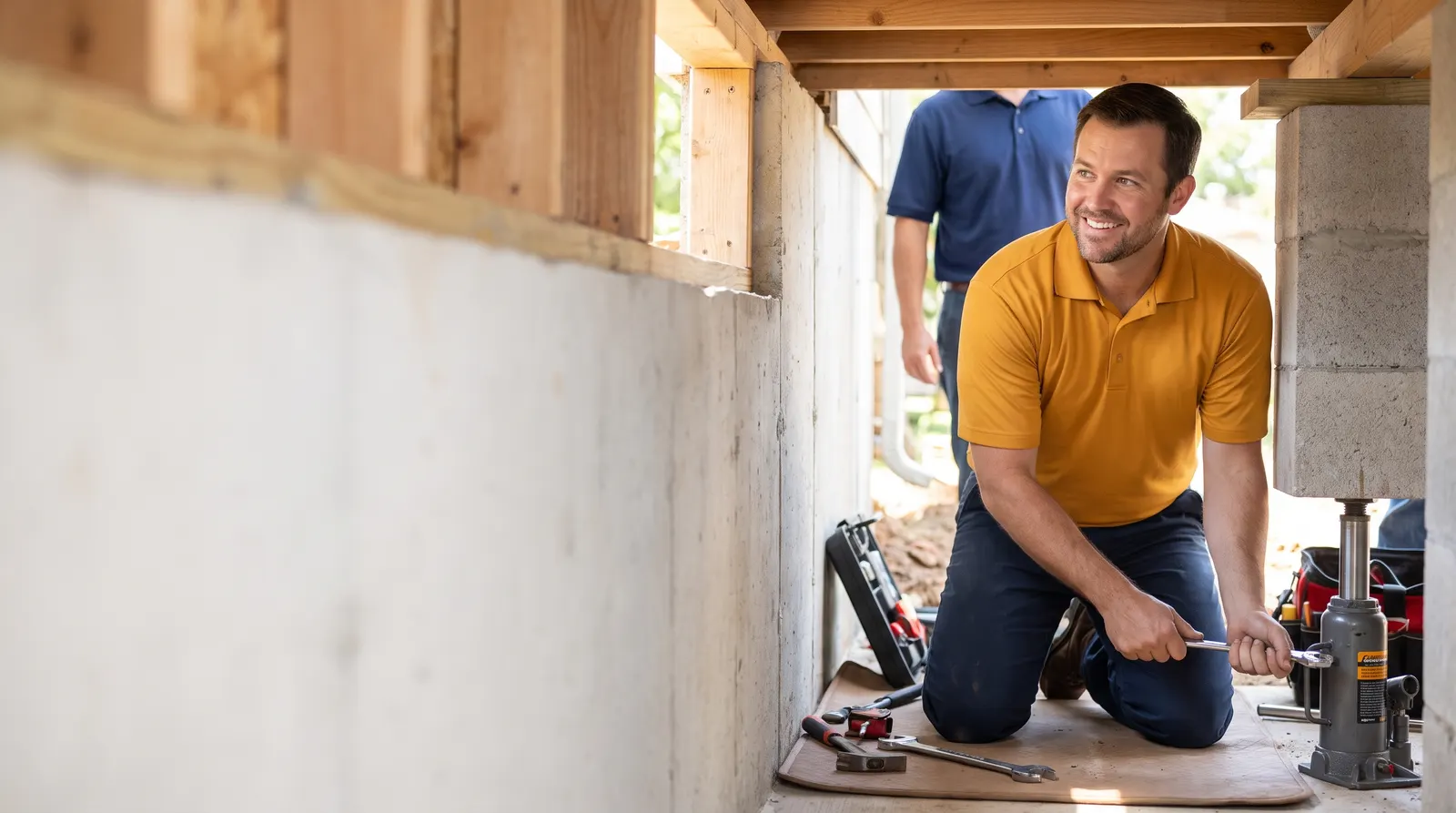
Foundation repair in Norman is the process of diagnosing, stabilizing, and restoring a home's structural base after Cleveland County's expansive clay soils shift, shrink, or heave beneath the slab or pier-and-beam system.
Every service reflects the same meticulous attention to detail, whether it's a single job or a larger foundation repair project across Norman.
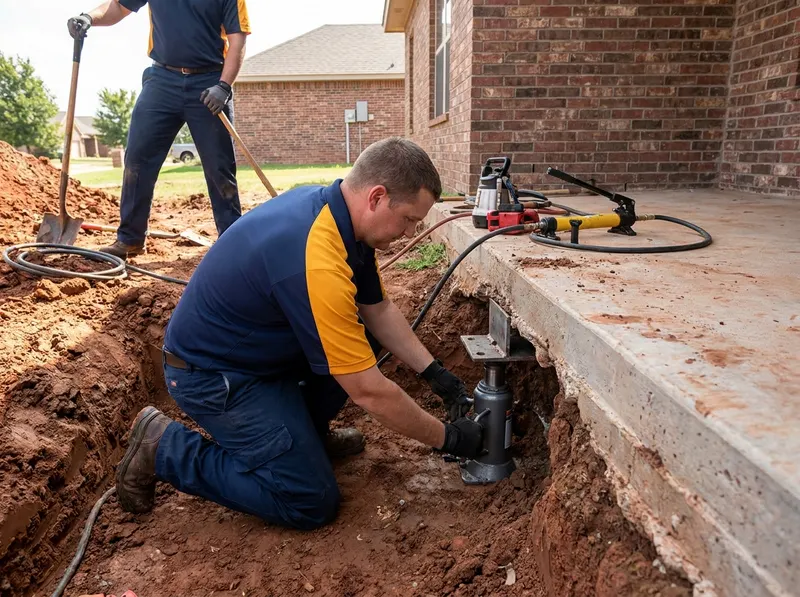
Most Norman homes built between 1960 and 2000 sit on post-tensioned or conventionally reinforced concrete slabs. When the clay beneath a slab dries unevenly, common along the south-facing lots in Colony West and Westwood Park, one section drops while another holds, producing the diagonal cracks and sticking doors homeowners notice first. Slab repair involves mapping the differential settlement with a zip level or optical instrument, identifying the low zones, and lifting or stabilizing those sections with pressed concrete piers or helical piers driven to load-bearing depth. The goal is not a perfectly level slab, it is a stable one that stops moving.
Get a quote →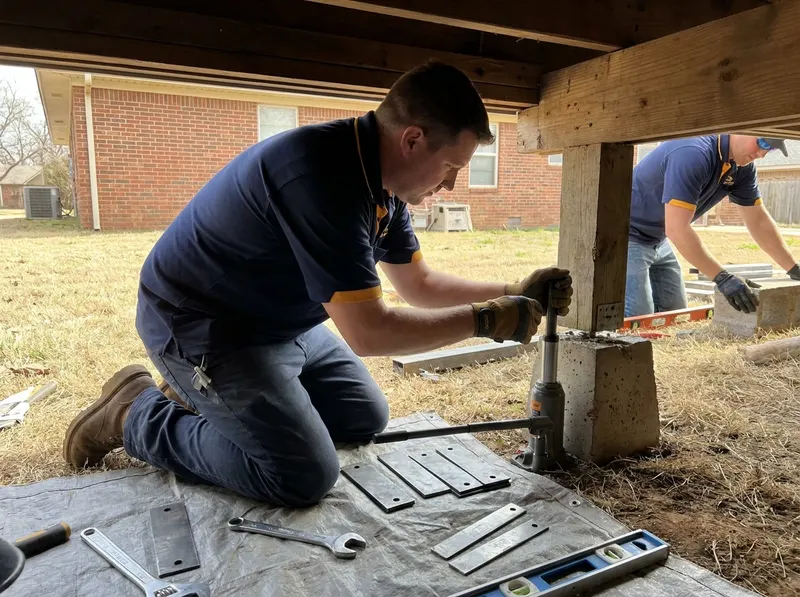
Older Norman homes near the University of Oklahoma campus and in established neighborhoods like Oakwood sometimes rest on pier-and-beam systems with a crawl space underneath. These foundations allow direct access to the beams and piers, which makes diagnosis straightforward: a technician can physically inspect rotted wood, failed shims, and settled center piers. Repair typically involves sistering damaged beams, replacing deteriorated wood posts with adjustable steel columns, or adding new concrete pads beneath settled piers. Moisture control in the crawl space is addressed at the same visit, because standing water under a pier-and-beam home is the primary driver of continued deterioration.
Get a quote →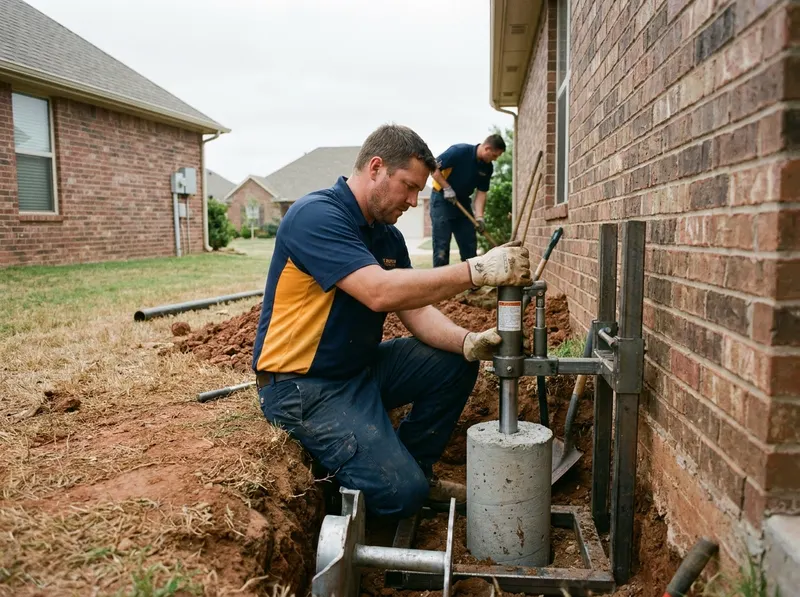
Pressed concrete piers are cylindrical concrete cylinders driven in sequence through a hydraulic ram until they reach refusal, the point where the soil or bedrock below resists further penetration. In Norman's geology, refusal typically occurs between 10 and 25 feet, depending on location and the depth of the clay layer. This method is cost-effective for standard residential slabs and has a long track record in Cleveland County. Each pier is driven from a small excavation at the foundation perimeter, and the slab is lifted incrementally as piers are installed. Landscaping disturbance is limited to the excavation footprint at each pier location.
Get a quote →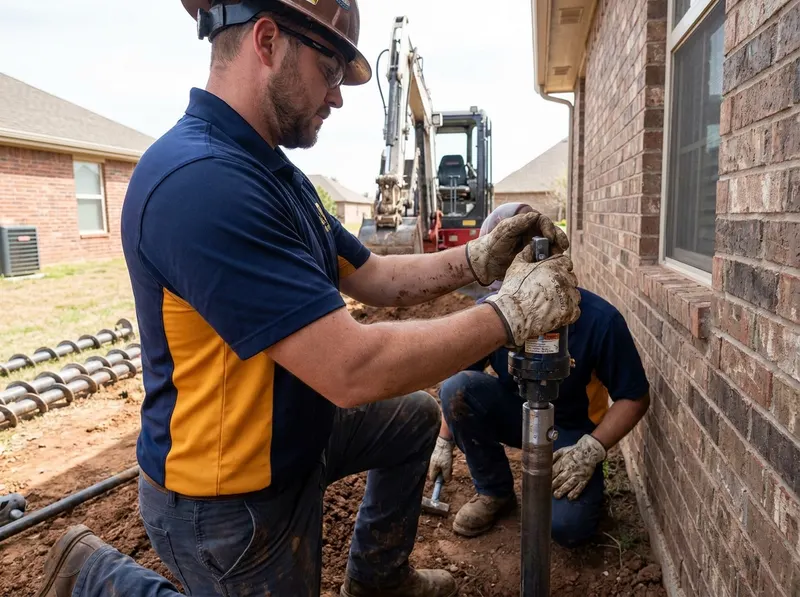
Helical piers are steel shafts with welded helix plates that are torqued into the soil by a hydraulic drive head. Because installation torque correlates directly with load capacity, each pier's bearing capacity is verified during installation, a measurable quality-control step that pressed piers do not offer. Helical piers suit situations where soil conditions are variable, where a structure is too light to generate the reaction force needed to drive pressed piers, or where a tight access point, a finished garage slab in Timberlake, for example, limits equipment movement. Extension sections are added until the helix plates reach competent bearing soil.
Get a quote →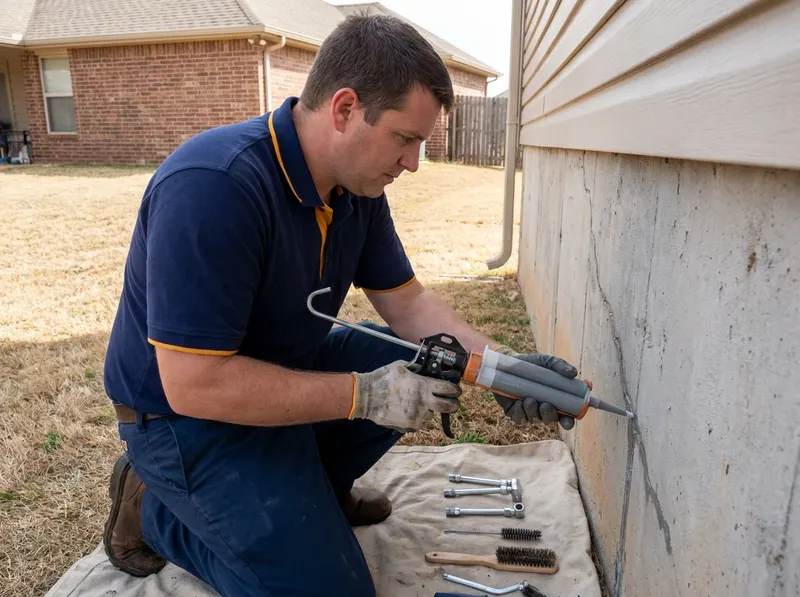
Not every crack signals structural movement. Shrinkage cracks in a concrete slab, typically hairline, random, and non-progressive, are cosmetic. Structural cracks are wider than 1/4 inch, follow a diagonal pattern, are wider at one end than the other, or have measurable vertical displacement across the crack face. Liftwell Foundation Repair evaluates each crack before recommending a fix. Epoxy injection is appropriate for static structural cracks in concrete where tensile strength restoration is the goal. Polyurethane foam injection suits active cracks where slight future movement is expected, because the cured foam remains flexible. Both methods are applied from the interior surface without excavation.
Get a quote →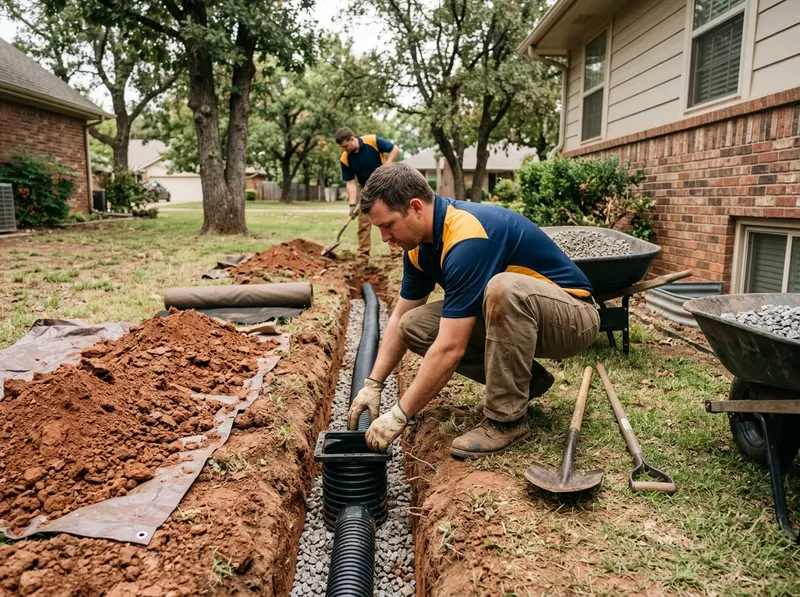
In Norman, the single most effective long-term foundation maintenance measure is controlling the moisture content of the clay soil at the perimeter of the slab. Gutters that discharge within 3 feet of the foundation, negative grades that slope toward the house, and missing downspout extensions all allow water to saturate the perimeter clay, causing it to expand and lift the edge of the slab while the interior dries and drops, a classic dish or center-lift pattern. Drainage correction involves extending downspouts, regrading the immediate perimeter, and in some cases installing a French drain to redirect subsurface water away from the foundation. Addressing drainage before or alongside pier installation measurably reduces the likelihood of future movement.
Get a quote →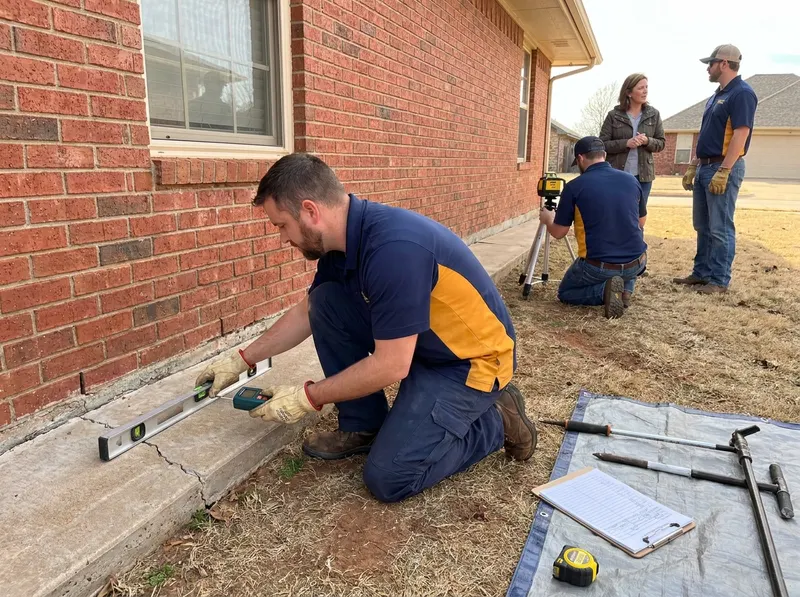
A foundation evaluation at a Norman home is a structured diagnostic visit, not a sales call. The technician measures floor elevations at multiple points across the slab, inspects all visible crack locations and orientations, checks door and window frames for racking, and reviews the exterior grade and drainage conditions. Findings are documented with measurements and photographs. The written summary distinguishes between conditions that require immediate repair, conditions worth monitoring over one or two seasons, and conditions that are cosmetic only. Homeowners who have received a large proposal from another contractor often schedule a second-opinion evaluation to get an independent read on what the ground is actually doing.
Get a quote →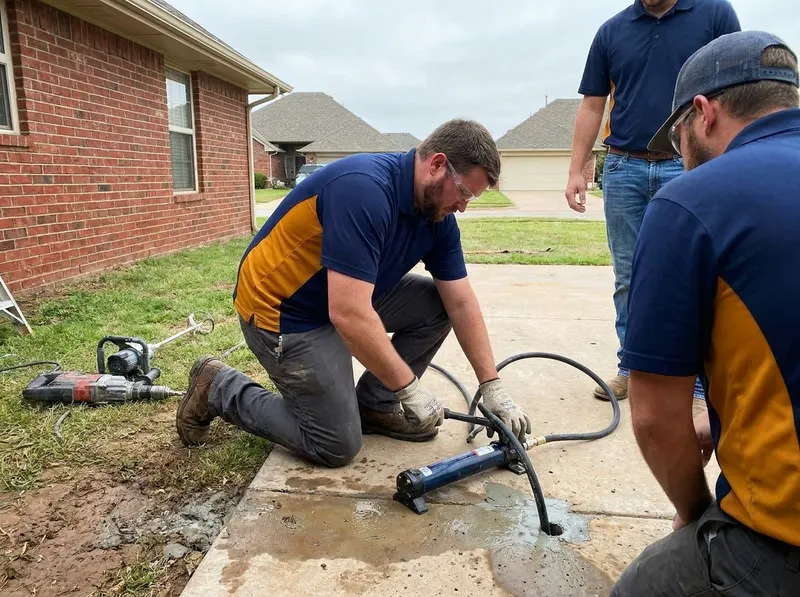
Mudjacking, also called slab jacking or pressure grouting, pumps a cement-soil slurry through small holes drilled in a sunken concrete slab to fill voids and lift the slab back toward its original elevation. It is appropriate for settled sidewalks, driveways, garage aprons, and porch slabs where the concrete itself is structurally sound but has dropped due to soil erosion or washout beneath it. Mudjacking is not a substitute for pier installation on a structural foundation slab, but it is a cost-effective and minimally invasive option for exterior flatwork. Hole diameter is typically 1.5 to 2 inches; holes are patched with concrete after grouting.
Get a quote →You get a firm, itemized quote for your foundation repair before any work begins, no surprises, no pressure.
Careful prep, tidy work, and a full cleanup when we are done. We treat your home and belongings like our own.
The same trusted, background-checked team from the first call to the final check.
Every project gets a firm, written price after a free on-site visit. Ranges below for orientation.
Norman sits on a geologic transition zone where the Garber Sandstone formation meets thick deposits of red Permian clay, the same expansive clay that makes Cleveland County's soil shrink measurably during the dry August and September periods that follow Oklahoma's typical summer heat. The U.S. Geological Survey maps this clay layer as having a high shrink-swell potential, which means a Norman slab can experience 1 to 3 inches of differential movement over a single drought-and-recharge cycle without any change in the structure above it. Homes in the older sections of Brookhaven and along the corridors near Griffin Memorial Hospital and Norman Regional Health System were frequently built in the 1970s and 1980s on slabs designed to the standards of that era, before the full shrink-swell behavior of the local clay was well-documented in residential construction practice, making periodic evaluation a routine part of responsible homeownership in this city.
 Liftwell Foundation Repair