Norman sits on a band of Renfrow clay loam and Port silt loam that can shift 3 to 5 percent in volume between a dry August and a wet April. That cycle is why a driveway in Brookhaven or a sidewalk panel in Timberlake…
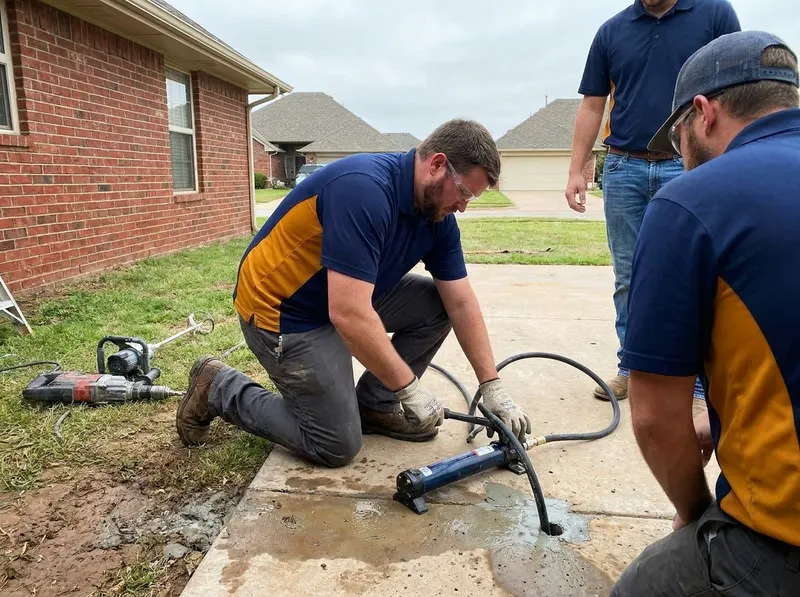
Norman sits on a band of Renfrow clay loam and Port silt loam that can shift 3 to 5 percent in volume between a dry August and a wet April. That cycle is why a driveway in Brookhaven or a sidewalk panel in Timberlake can look level in spring and drop a visible inch or more by the time summer ends. Mudjacking addresses that specific mechanism: it does not just fill a void, it re-establishes contact between the slab and the soil so the panel stops rocking and draining toward the foundation. The slurry used in the process, a mix of Portland cement, soil fines, and water, is heavier than the polyurethane foam some contractors offer, which makes it well suited to the denser substrate found under older Norman slabs poured in the 1970s and 1980s when Shadowridge, Colony West, and Whispering Heights were being developed.
The process runs in four numbered steps. 1. A technician marks a grid of hole locations on the settled panel, typically spaced 3 to 4 feet apart. 2. A rotary drill cuts 1.5-inch to 2-inch holes through the slab, the slab itself is not removed. 3. A pump pushes slurry through a nozzle inserted in each hole, filling the void and gradually lifting the panel; the technician monitors elevation with a level and stops pumping when the target grade is reached. 4. Each hole is patched with hydraulic cement, ground flush, and the slab is ready for light foot traffic within roughly 90 minutes. Driveway traffic typically resumes the following day.
Mudjacking fits best when the concrete panel itself is structurally sound, no cracks wider than a half-inch, no broken or crumbling edges, and when the settlement is caused by soil shrinkage or a washed-out void rather than by an underlying structural problem with the home's foundation. A patio slab in Oakwood that has dropped two inches on one corner because of a dry summer is a strong candidate. A garage floor in University North Park that has cracked into four separate pieces and shows differential movement between sections is not, that situation calls for a foundation evaluation first. Liftwell Foundation Repair technicians distinguish between the two during the on-site visit, and they will say clearly when mudjacking is not the right tool, because lifting a compromised panel does not fix what broke it.
For homeowners in Brookfield Estates or Greens at Westport who have received a quote for full concrete replacement, mudjacking is worth comparing directly: replacement typically runs two to three times the cost of mudjacking for the same square footage, requires a cure period of 28 days before heavy vehicle traffic, and involves saw-cutting and hauling away the existing slab. Mudjacking preserves the original pour, generates almost no demolition debris, and in most Norman residential settings is complete before lunch. The trade-off is longevity, mudjacked slabs can re-settle if the underlying soil continues to cycle dramatically, which is why addressing irrigation patterns and downspout discharge near the lifted slab extends the result. A technician will point out those drainage factors during the visit so the repair holds as long as possible.
Every job gets a firm, written price after a free on-site visit.
Tell us about your mudjacking and slab leveling job in Norman and we'll send a clear, written quote, usually the same day.
 Liftwell Foundation Repair